
 Posts
Posts


When I first moved here when I was six, my uncle introduced me to the little girl across the street. We quickly became friends, the type that's more like a sister in that the two of us could bicker and make up in the span of ten minutes. I spent a lot of time around her family and vice versa, and we picked up each others' quirks. They had this phrase they used in their family called "goo gee ga," which meant, in a word, junk--the kind of stuff that sits in a drawer somewhere that you never look at, but still can't bear to throw out.
Back then, I had an entire bureau that was full of goo gee ga. Over the years, and especially since I got back from college, quite a bit of it has disappeared. But now I'm moving, and it keeps surprising me when I find things from my past that I'd completely forgotten about.
The worst are the pictures. Awkward school photos from high school that I thought might come in handy someday, books full of photos from the days before digital cameras when you just had to take what you got when the film was developed, envelopes of pictures from a family trip to Disney World that never made it into albums or frames. Then there's the scratchy blanket I used to keep on my bed when I was a kid, the boxes of old birthday cards, the Polaroid camera I got one Christmas for which I can no longer buy film. Tons of books that I'll never read again, cute pictures my little brother drew me in school, instruction booklets for cell phones and electronics that I haven't used in years. Almost-empty notebooks left over from school and saved to provide scratch paper. A half-finished scrapbook of high school events that seemed important but that I can't bring myself to complete now. A monkey carved out of coconuts that my boyfriend calls "creepy" but that I can't bear to part with because my uncle brought it to me as a souveneir from a tropical vacation before he passed away.
My life has been taken over by goo gee ga now. Most of it will probably end up in my parents' garage, in a back corner upstairs to collect dust until they go through and make me throw it out 10 years from now. Will it seem more valuable then, or will I have saved it for nothing? Should I assume that if I don't need it for the next chapter of my life in Washington, D.C., then I won't ever look back for it at all?
Either way, Travelphilia is moving--to Washington, D.C., to be exact, for my new job. The goo gee ga problem explains my hiatus from posting, but I should be back on track after I've settled in and found an apartment. In the meantime, it's goodbye Boston, hello D.C.!
Wednesday, March 11, 2009


Friday, February 27, 2009
Site feature: Trazzler.com
I stumbled upon Trazzler.com at the beginning of this month, and thought the site idea was really interesting. Yes, it's another in a slew of travel sites that have been popping up lately, but Trazzler is focused more on conveying the experience of a moment rather than guidebookish, statistic-filled writing. As the company writes on its About page, "Trazzler places you emotionally into specific moments and locales all over the planet and helps you explore the limitless travel opportunities our world has to offer."
So as part of the signup deal (which is free, by the way), it offers suggestions of activities nearby, phrased as actions and not as places. And travel is really about doing, not seeing, right?
I've signed up as a writer and written a couple of trips just to test the waters, drawing on some of my experiences while I was in Europe. It's made me take a whole new look at travel writing, so expect to see some more up as I find the time over the next few weeks.
So as part of the signup deal (which is free, by the way), it offers suggestions of activities nearby, phrased as actions and not as places. And travel is really about doing, not seeing, right?
I've signed up as a writer and written a couple of trips just to test the waters, drawing on some of my experiences while I was in Europe. It's made me take a whole new look at travel writing, so expect to see some more up as I find the time over the next few weeks.
Wednesday, February 25, 2009
Bigger perspectives
This afternoon, I went for a run downtown to wind down and took a detour through my grandparents' old neighborhood. I passed the house where they lived for much of my childhood, before they moved down south when I was around 10. I don't pass through that neighborhood often, so it always startles me when I find the house looking about half the size it does in my mind. Some of the changes can be attributed to lack of upkeep on the part of the new owners--the untrimmed bushes that block the windows, the overgrown garden, the paint that peels in some spots--but I know the expansive porch where I see my grandfather smoking his pipe in my mind's eye is still the same one that is tucked away in a corner now, and that the looming staircase hasn't shortened into the one there today that I could take in a few leaps. I grew up in that house, and yet it looks almost like something I saw in a dream once. I imagine it's a similar feeling to when you meet someone at a high school reunion years after graduation and find it hard to place the image of the dreamy football star you remember from high school in the bald, paunchy, dilapidated person you see before you.
It's almost the exact opposite situation when I visit Washington, D.C. Before I visited on a business trip last June, I had only been there once, on an eighth grade school field trip. I vaguely remember being near the Lincoln Memorial walking along the National Mall at dusk, and walking by a big white building in the pouring rain, that I honestly can't place. I remember clearly who I roomed with in the hotel we occupied, the scandal that ensued after two classmates of opposite sexes were rumored to have sneaked a rendezvous in the boy's room after bedtime, and being shocked when a stranger sat down at a table my friends and I were occupying in a crowded cafeteria while we ate lunch somewhere. I don't even have pictures to refresh my memory: this was all before the days of digital cameras, and a friend offering to help me load my film into my camera did it incorrectly.
 So when I visit now, I find it hard to associate what has quickly become one of my favorite cities with the dreary D.C. that barely made an impression on me beyond the chance to stay in a hotel with my friends. On that same business trip last June, I wandered around the National Mall for a few hours one warm afternoon, then sat by the Washington Monument and called my best friend to tell her I was moving there someday. I get a similar feeling there as I do in Boston--it has an honest, lovable feel about it that just makes me feel at home right away. I actually forget that I was even there as a 13 year old, because it seems like that place I visited way back then was in a completely different universe than the city I see now. I guess it's all about your perspective.
Photo courtesy NCinDC via the Flickr Creative Commons
It's almost the exact opposite situation when I visit Washington, D.C. Before I visited on a business trip last June, I had only been there once, on an eighth grade school field trip. I vaguely remember being near the Lincoln Memorial walking along the National Mall at dusk, and walking by a big white building in the pouring rain, that I honestly can't place. I remember clearly who I roomed with in the hotel we occupied, the scandal that ensued after two classmates of opposite sexes were rumored to have sneaked a rendezvous in the boy's room after bedtime, and being shocked when a stranger sat down at a table my friends and I were occupying in a crowded cafeteria while we ate lunch somewhere. I don't even have pictures to refresh my memory: this was all before the days of digital cameras, and a friend offering to help me load my film into my camera did it incorrectly.
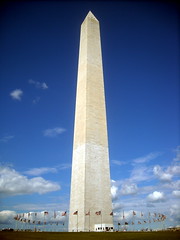 So when I visit now, I find it hard to associate what has quickly become one of my favorite cities with the dreary D.C. that barely made an impression on me beyond the chance to stay in a hotel with my friends. On that same business trip last June, I wandered around the National Mall for a few hours one warm afternoon, then sat by the Washington Monument and called my best friend to tell her I was moving there someday. I get a similar feeling there as I do in Boston--it has an honest, lovable feel about it that just makes me feel at home right away. I actually forget that I was even there as a 13 year old, because it seems like that place I visited way back then was in a completely different universe than the city I see now. I guess it's all about your perspective.
Photo courtesy NCinDC via the Flickr Creative Commons
Tuesday, February 17, 2009
Home, wherever that may be
For the past 11 years, my family has headed coastal North Carolina for a two-week vacation smack dab in the middle of July. To be specific, our destination of choice is Topsail Island (pronounced Top-suhl, not Top-sail), located just south of the outer banks. The island is exquisite: 18 miles of gorgeous sand, waving grass on the dunes, and enormous, dark blue waves, all visited occasionally by packs of dolphins who are adept surfers, to the delight of beachgoers. If you drive all the way south, then park and walk about a quarter mile out to the tip of the island, you'll think you just walked into heaven: the ocean and the clear blue waters of the Intracoastal Waterway merge together just beyond untouch ed white sand, forming ever-changing tidepools and currents to play in. If you stay out there long enough, you can sit on a totally empty beach and watch one of only a handful of water sunsets on the East Coast as the sun sinks below the mainland on the other side of the Intracoastal Waterway.
Sounds like a relaxing vacation, right? Now factor in the following: my immediate family of six drives--yes, drives--from our home in Massachusetts to get there, leaving on Friday evening and taking turns at the wheel overnight to arrive by breakfasttime. That includes my third-grade brother, who, God bless him, sleeps most of the night and wakes up claiming to have stayed up for the whole drive, plus four other full-grown adults. When we get there, we meet up with my father's five siblings and their families, including nine cousins and their spouses and kids, plus my grandparents. Every year, the gang seems to grow--long-lost second and third cousins, inlaws from other sides of the family, and new babies and significant others pop up all the time to join in the fun. At times, we number close to 50, although nobody will hold still long enough to get a good count. We rent houses in the same area and hit the beach by day, then share blenders full of margaritas and guitar duets on the deck by night.
Not to mention the character of the island. Even though we only spend two weeks there a year, the guy who owns the local fish shop remembers us every single year when we return. So does the owner of the putt-putt golf course, where we frequently stop for ice cream. The rickety old pier plays host to a whole cast of characters if you walk out far enough, and they'll all be happy to become your new best friend if you give them the time. We always make sure to spend a night at the Crab Pot, a sweaty seafood joint downtown featuring kareoke nights that my family invariably takes over with our enormous numbers. By the end of the night, we've extended our circle of friends by at least the 25 other people in the bar.
As we drive over that short bridge, we all feel like we're coming home.
This island is so much a part of my life that sometimes I literally ache for it. My Boston accent and prolific use of "wicked" as an adverb give away my out-of-towner status, but this one of the few places besides my real hometown where I'm truly not a tourist, even if I am even there for only two weeks of the year. It's a place where I've grown up and gained so much of who I am today that it couldn't ever be anything but home.
 ed white sand, forming ever-changing tidepools and currents to play in. If you stay out there long enough, you can sit on a totally empty beach and watch one of only a handful of water sunsets on the East Coast as the sun sinks below the mainland on the other side of the Intracoastal Waterway.
Sounds like a relaxing vacation, right? Now factor in the following: my immediate family of six drives--yes, drives--from our home in Massachusetts to get there, leaving on Friday evening and taking turns at the wheel overnight to arrive by breakfasttime. That includes my third-grade brother, who, God bless him, sleeps most of the night and wakes up claiming to have stayed up for the whole drive, plus four other full-grown adults. When we get there, we meet up with my father's five siblings and their families, including nine cousins and their spouses and kids, plus my grandparents. Every year, the gang seems to grow--long-lost second and third cousins, inlaws from other sides of the family, and new babies and significant others pop up all the time to join in the fun. At times, we number close to 50, although nobody will hold still long enough to get a good count. We rent houses in the same area and hit the beach by day, then share blenders full of margaritas and guitar duets on the deck by night.
Not to mention the character of the island. Even though we only spend two weeks there a year, the guy who owns the local fish shop remembers us every single year when we return. So does the owner of the putt-putt golf course, where we frequently stop for ice cream. The rickety old pier plays host to a whole cast of characters if you walk out far enough, and they'll all be happy to
 become your new best friend if you give them the time. We always make sure to spend a night at the Crab Pot, a sweaty seafood joint downtown featuring kareoke nights that my family invariably takes over with our enormous numbers. By the end of the night, we've extended our circle of friends by at least the 25 other people in the bar.
As we drive over that short bridge, we all feel like we're coming home.
This island is so much a part of my life that sometimes I literally ache for it. My Boston accent and prolific use of "wicked" as an adverb give away my out-of-towner status, but this one of the few places besides my real hometown where I'm truly not a tourist, even if I am even there for only two weeks of the year. It's a place where I've grown up and gained so much of who I am today that it couldn't ever be anything but home.
Wednesday, February 11, 2009
Place of the week: Newseum
 Photo: Courtesy NC in DC via the Flickr Creative Commons
You don't have to be a news junkie to appreciate the Newseum, D.C.'s museum dedicated to--you guessed it--all things news. Start in the basement to see the largest display of chunks of the Berlin Wall outside of Germany, then take the glass elevator all the way to the top and work your way down. Take your time on the information-heavy top floor: the best place to start is the Today's Front Pages gallery, where you can see printouts of what people all over the world read on their front pages that very day. The outside terrace offers a great photo op with the U.S. Capitol as a backdrop, weather permitting. The News Corp. News History Gallery features slide-out displays of historical headlines from the earliest days of the press up through recent years, outlining piviotal moments from the Salem Witch Trials to World War I. The 9/11 Gallery provides a haunting reminder of that day, with a wall of front pages announcing the news and a video showing the thoughts of journalists who covered the event. Downstairs, you can watch a live broadcast on NPR, try your hand at reporting in the NBC News Interactive Newsroom, or pay homage to journalists who died on the job.
Newseum
555 Pennsylvania Ave., N.W., Washington, DC 20001
Phone: 888 639 7386
Web: www.newseum.org
Tuesday, February 3, 2009
Place of the week: Holocaust Memorial
 Photo: Courtesy ewen and donabel on the Flickr Creative Commons
Winter evenings are an especially haunting time to visit the Holocaust Memorial in Boston. Right in the middle of the action by Faneuil Hall, you'll find the six towers representing the six main Nazi concentration camps, eerily reminiscent of smokestacks. The glass surfaces of the 54-foot structures are etched with a total of six million numbers, like icy versions of the tattoos given to prisoners during the Holocaust. Take the time to fully absorb the magnitude of the Holocaust and notice all the little details, like the way the smouldering flames at the bottom of each tower light up an inscription of the name of a concentration camp.
The Holocaust Memorial
Located on Congress Street, along the Freedom Trail. To get there by T, head to the Haymarket, State Street, or Government Center stops--all are within walking distance of the site.
Phone: 617 457 8755
Web: www.nehm.org
Friday, January 30, 2009
Venturing out of season
New England has been pummeled with feet of snow and inches of ice over the past few months. Hundreds of thousands of residents in central Massachusetts and New Hampshire lost power for weeks around Christmastime after a monstrous storm that blanketed roads and power lines in ice. My driveway is a skating rink, and I have to scrape a layer of frost off my car every morning before work.

So it's going to sound strange when I say that this is a great time of year to visit Massachusetts.
There's something that binds together all us crazy people who brave the elements up here when the snow won't stop and our backs are aching from shoveling the walks. We grew up sledding after school and building backyard ice rinks. When we learned to drive, our parents made us practice in two feet of snow so we'd learn what happened when we slammed on the brakes in the middle of a slide: "Scary, huh? You don't wanna do that again, do ya?" (My dad took it one step further and showed me how to operate the snow plow on his truck when I turned 16, "just in case.") We carried an extra set of clothes to elementary school to change after recess when our pants, mittens, socks, and hats were soaked through. When we played with the neighborhood kids, the parents would make us go outside for fresh air, no matter how much snow was on the ground; we'd only be allowed to come back inside for hot chocolate and marshmallows after our noses and ears were thoroughly pinked.
There's a shared experience that pulls together New Englanders when the temperatures drop. We're survivors. We have suffered blizzards in April that kill off the first crocuses daring to push through the soil. We have walked with the bundled masses to get to school, to work, to social engagements. We root on our sports teams with even more fervor when we have to scrape the snow off our seats. Subzero wind chills can't bring us down. It's part of our culture.
And you're going to miss out on witnessing that culture when you visit on a balmy weekend in June.
In case you're wondering, the above photo is from a particularly nasty February storm when I was in school at the University of Massachusetts. Walking to class in six inches of pure slush is an experience in and of itself.

So it's going to sound strange when I say that this is a great time of year to visit Massachusetts.
There's something that binds together all us crazy people who brave the elements up here when the snow won't stop and our backs are aching from shoveling the walks. We grew up sledding after school and building backyard ice rinks. When we learned to drive, our parents made us practice in two feet of snow so we'd learn what happened when we slammed on the brakes in the middle of a slide: "Scary, huh? You don't wanna do that again, do ya?" (My dad took it one step further and showed me how to operate the snow plow on his truck when I turned 16, "just in case.") We carried an extra set of clothes to elementary school to change after recess when our pants, mittens, socks, and hats were soaked through. When we played with the neighborhood kids, the parents would make us go outside for fresh air, no matter how much snow was on the ground; we'd only be allowed to come back inside for hot chocolate and marshmallows after our noses and ears were thoroughly pinked.
There's a shared experience that pulls together New Englanders when the temperatures drop. We're survivors. We have suffered blizzards in April that kill off the first crocuses daring to push through the soil. We have walked with the bundled masses to get to school, to work, to social engagements. We root on our sports teams with even more fervor when we have to scrape the snow off our seats. Subzero wind chills can't bring us down. It's part of our culture.
And you're going to miss out on witnessing that culture when you visit on a balmy weekend in June.
In case you're wondering, the above photo is from a particularly nasty February storm when I was in school at the University of Massachusetts. Walking to class in six inches of pure slush is an experience in and of itself.
Thursday, January 29, 2009
Place of the week: Anne Frank House

Don't be deterred by the long line outside the Anne Frank House in Amsterdam--what awaits inside is well worth the time. At first, the museum won't seem like much; as you walk through, you'll notice stenciled quotes from the book on the walls and a few pictures and video exhibits. But the weight of history settles in as soon as you pass the bookcase that hid the door and enter the actual annex where the now-famous Anne Frank and her family hid from the Nazis. These small rooms are the place where a teenaged Anne spent two years, so the true power of the museum is in the details. Make sure to read the brochure so you don't miss the subtleties of the space, like the pencil marks on the walls where Otto Frank measured his daughters' growth while they were in hiding. You'll see the pictures of movie stars Anne hung on the wall to make the tiny room "look much more cheerful," as she writes in her diaries. Upstairs, a glass passageway takes visitors to the front part of the attic; look overhead for another stenciled quote from the diaries: "The English radio says they're being gassed. I feel terribly upset." Her first diary is on display in a glass case; as you examine it, her handwriting will recall her striking youth during the whole ordeal. The exhibits end with letters written by Anne's father when he found out his daughters had died in concentration camps.
Tip: Visit first thing in the morning to minimize your wait time.
Anne Frank House
Prinsengracht 267, Amsterdam
Phone: +31 (0) 20 5567100
Web: www.annefrank.org

Monday, January 19, 2009
Place of the week: International Spy Museum
The spy industry survives on its own implicit secrecy, so that’s probably why we find the idea of the International Spy Museum so fascinating—it opens doors that you’ve only been able to imagine from the array of Hollywood spy blockbusters. From the very beginning, the tour puts visitors in the shoes of a spy, assigning everyone a secret identity and testing memory and observational skills at video-screen checkpoints along the way. The rest of the museum is mostly informational, with a smattering of interactive games and exhibits along the way—plus a chance to crawl through ductwork above the exhibit rooms and eavesdrop on simulated conversations below. The Spy Museum has an extensive collection of spy gadgets, from a gun disguised as a tube of lipstick to a pair of glasses that hide a dose of cyanide. The history involved is perhaps the best part: learn about little-known spymasters Harriet Tubman, Moses, and George Washington, then see the espionage-tinged back-story behind events that have changed the world, from Pearl Harbor to the Cold War. Plan on arriving first thing in the morning in order to get the most bang for your buck; otherwise, the huge crowds will really detract from the experience. The interactive features are fun, but if there are large waves of people coming through, you likely won’t get a chance to try them out anyway. If this is the case, grab a bite at the café or check out the gift shop for some cool spy-themed souvenirs.
The International Spy Museum
800 F St., NW, Washington, D.C.
Phone: 202 393 7798
Web: www.spymuseum.org
The International Spy Museum
800 F St., NW, Washington, D.C.
Phone: 202 393 7798
Web: www.spymuseum.org
Tuesday, January 6, 2009
Sight unseen

A few months ago, I drove out to Western Massachusetts to visit some friends at UMass, my alma mater. Although I lived in Amherst for four years and had made countless trips along I-90 and through the back roads of Palmer and Belchertown, I noticed the eye-popping colors of the foliage covering the hills more than I had ever remembered doing in the past.
At first I thought it must just be peak foliage, but I had been there through four autumns and never really taken the time to notice my surroundings. I realized that every time I'd made the
 drive, I was just in a rush to get to my destination, whether it was a class, a meeting, or the comfort of home. When a place becomes part of the everyday, it's easy to let it pass by without a second glance.
But no matter how many times you've been there, when you have a new purpose, you can see it through different eyes.
When I was in Seville, I was constantly surrounded by flowering orange trees, quaint parks, and landmarks that went back thousands of years. My friends and I used the cathedral, built in the 15th and 16th centuries, as a meeting place when we were going out for a night on the town. Half of the time, we forgot we were standing next to a church that generations and generations had worked on and worshipped in.
When my parents and friends came to visit at the halfway point of my stay, I suddenly became a t
 our guide. La Giralda, or the belltower of the cathedral, suddenly transformed into an incredible feat of architecture and engineering. Every new food was a wonder to them, and every treat was a delicacy. They couldn't believe how lucky I was to be living in that place, and I started to appreciate it in a new light, too.
I started taking more and more runs to explore the city and making wide detours on my way home from class. I'd spontaneously take a bus to the river to enjoy the views of Seville's ancient neighborhoods. I took more pictures. I stopped trying to get the city to conform to my on-the-go, rush-rush lifestyle and started taking my coffee at the cafe table and sipping it leisurely, the way it was meant to be enjoyed.
All I needed was a new pair of eyes to see a completely different city.
Monday, January 5, 2009
Save Our Trip
I read an interesting article today on the New York Times Online about travel risk management companies--something I'd never heard about before. With political and social skirmishes taking a larger toll on business travelers and vacationers, most recently in Mumbai, it seems that people have been turning more and more to professional help in case of emergency.
Although it points out that most situations have to do with accidents or theft, you can't help but think what a savior it would be in a more serious situation--one with national or global ramifications. People aren't just traveling to Canada anymore; destinations range all over the globe, where customs and safety issues might be drastically different from the home territory.
There's something comforting about exploring within the United States, where you know the rules and where you can go in a worst-case situation. We're trained to call 911, to scream for help, to run in the opposite direction. But what happens if you don't know the way? What happens if nobody will come to your rescue or you can't speak the language? What happens if the authorities won't help, either?
In this day and age, there's no reason not to use the communication technology we have to the fullest advantage possible. It's about time we gather our resources and help one another, because there's no telling what could happen if you make the wrong move.
Last spring, I took a vacation trip to the Dominican Republic with several friends. I was amazed by the difference between the resort life and the rest of the country--almost to the point that I was losing sleep over it. We landed our plane in Punta Cana and had to drive about an hour to our resort in a rickety old van, passing some truly appalling conditions, from barefoot kids on the side of the road to emaciated horses tied to trees. It was so drastically different from where we landed in Boston, or even in Puerto Rico, that we almost couldn't imagine it was in the same hemisphere.
I realized that we had no idea what the customs were there if something bad were to happen. It's not something you think about when you book a tropical resort trip, because it's impossible to imagine anything beyond sun and sand. But when my roommate and I both woke up on the same night with sweats and nausea, taking turns sprinting to our hotel bathroom, all I could think was that if we didn't get better, we wouldn't have our safe, clean, regulated United States hospitals to fall back on. I had friends who had gotten sick in Spain and in Ghana and who experienced firsthand the ghastly conditions that some hospitals overseas can have. Granted, it depends widely on the location and the situation, but I had to wonder what kind of medical infrastructure this host country would provide.
It would make me feel good to know that there's a system behind me that could walk me through the things I don't know how to handle. The travel world is growing all the time, and this certainly seems to be a positive expansion.
Although it points out that most situations have to do with accidents or theft, you can't help but think what a savior it would be in a more serious situation--one with national or global ramifications. People aren't just traveling to Canada anymore; destinations range all over the globe, where customs and safety issues might be drastically different from the home territory.
There's something comforting about exploring within the United States, where you know the rules and where you can go in a worst-case situation. We're trained to call 911, to scream for help, to run in the opposite direction. But what happens if you don't know the way? What happens if nobody will come to your rescue or you can't speak the language? What happens if the authorities won't help, either?
In this day and age, there's no reason not to use the communication technology we have to the fullest advantage possible. It's about time we gather our resources and help one another, because there's no telling what could happen if you make the wrong move.
Last spring, I took a vacation trip to the Dominican Republic with several friends. I was amazed by the difference between the resort life and the rest of the country--almost to the point that I was losing sleep over it. We landed our plane in Punta Cana and had to drive about an hour to our resort in a rickety old van, passing some truly appalling conditions, from barefoot kids on the side of the road to emaciated horses tied to trees. It was so drastically different from where we landed in Boston, or even in Puerto Rico, that we almost couldn't imagine it was in the same hemisphere.
I realized that we had no idea what the customs were there if something bad were to happen. It's not something you think about when you book a tropical resort trip, because it's impossible to imagine anything beyond sun and sand. But when my roommate and I both woke up on the same night with sweats and nausea, taking turns sprinting to our hotel bathroom, all I could think was that if we didn't get better, we wouldn't have our safe, clean, regulated United States hospitals to fall back on. I had friends who had gotten sick in Spain and in Ghana and who experienced firsthand the ghastly conditions that some hospitals overseas can have. Granted, it depends widely on the location and the situation, but I had to wonder what kind of medical infrastructure this host country would provide.
It would make me feel good to know that there's a system behind me that could walk me through the things I don't know how to handle. The travel world is growing all the time, and this certainly seems to be a positive expansion.
Subscribe to:
Posts (Atom)